AI-driven knowledge base for small and medium businesses
The AI that answers from your own documents.
Kmstry turns questions about procedures, contracts and company documentation into answers your team can trust. Sources are cited explicitly, and everyone gets answers only from the documents their role lets them see.
Your company already has the answers. They are buried in PDFs, Word files, PowerPoint presentations, and Excel spreadsheets.
And nobody has an afternoon to go looking for them.
What it is
A shared, informed and practical use of AI, designed around the needs of small and medium businesses.
Answers from your own documents
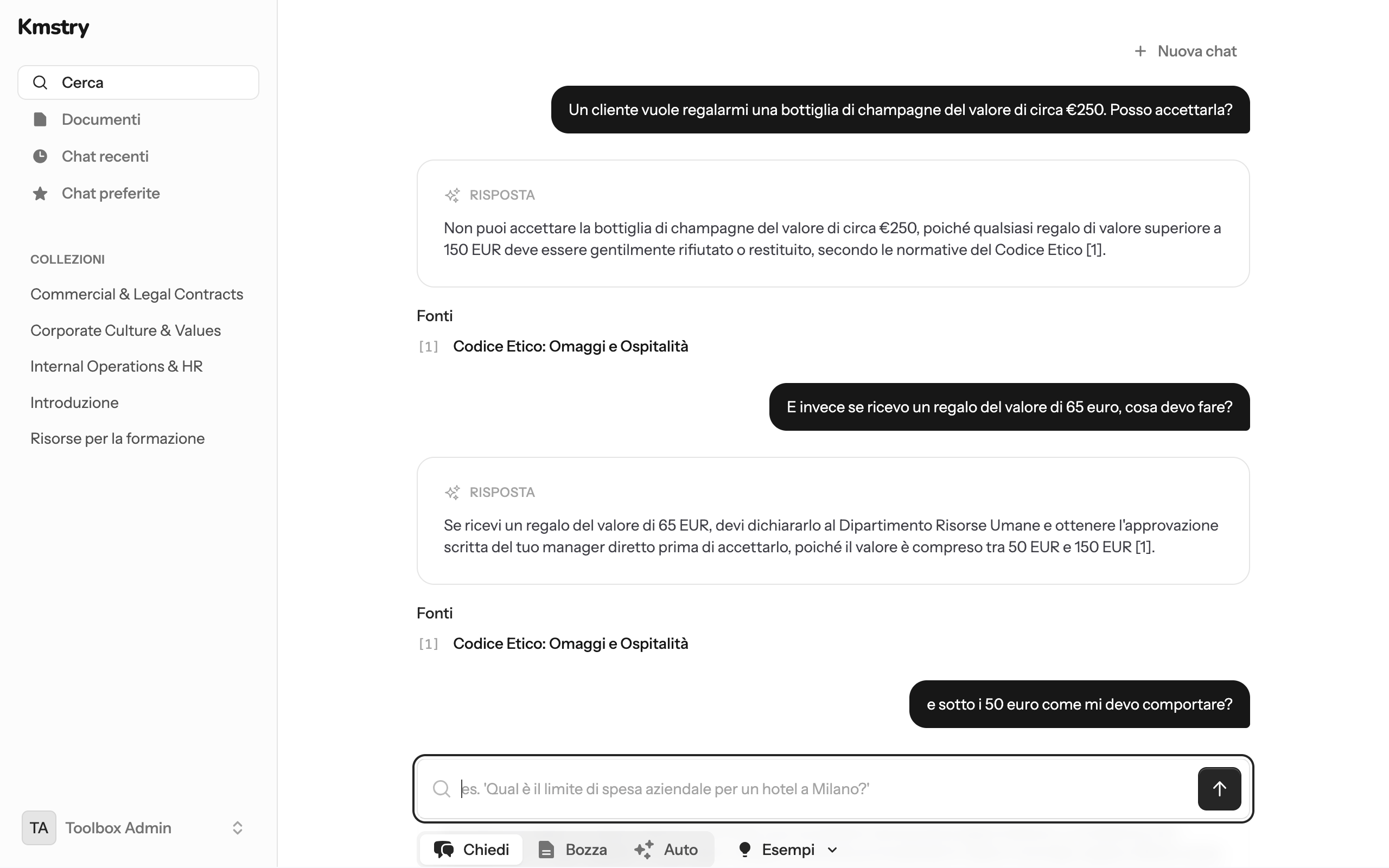
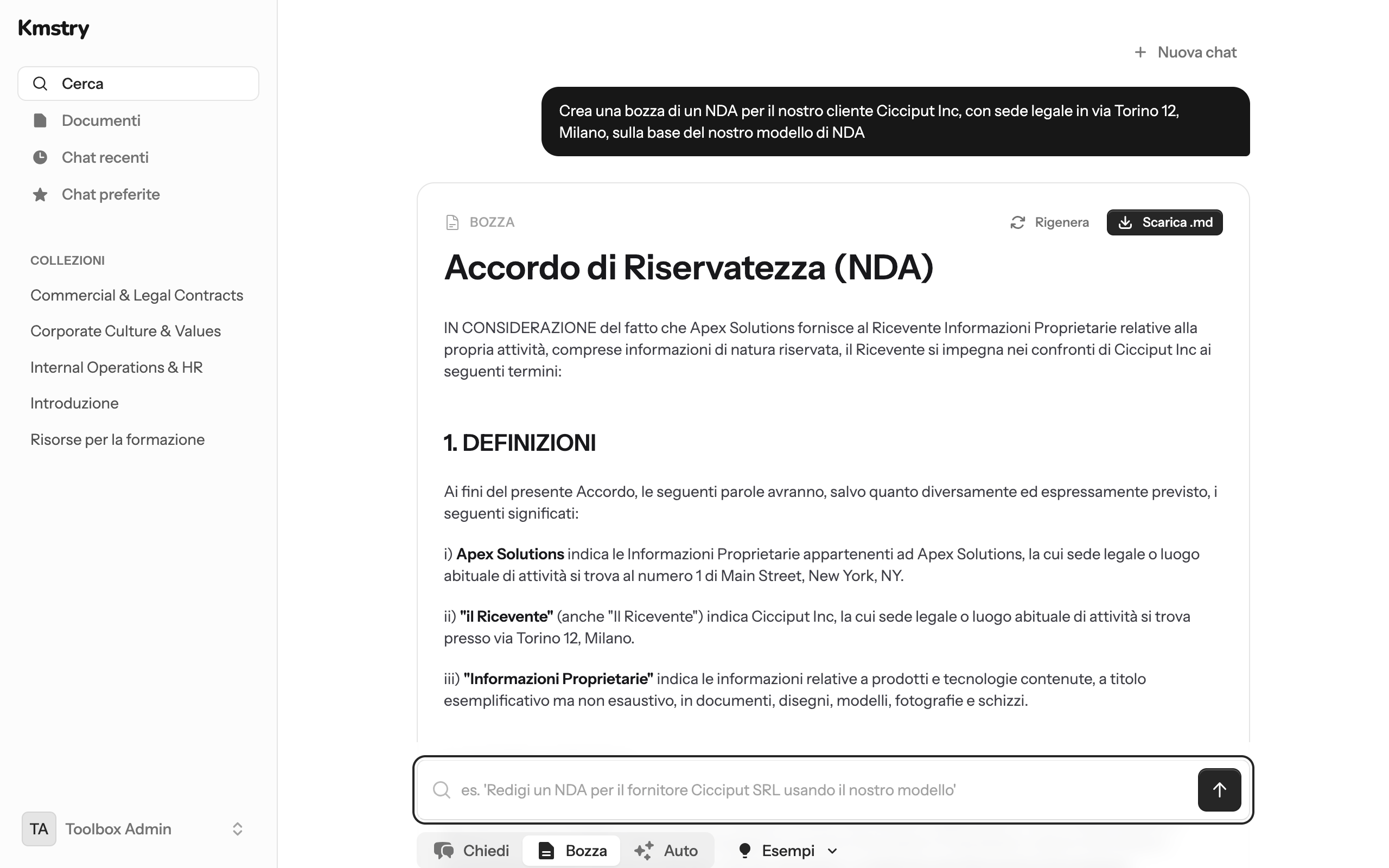
Upload procedures, contracts and technical sheets, or write them directly in Kmstry. Every answer cites the documents it came from, so nobody has to trust a sentence that arrived from nowhere.
You choose which AI to use
Connect Kmstry to the leading models from OpenAI, Anthropic or Google. OpenRouter reaches almost all of them with a single key. Ollama runs the model on your own infrastructure, for when the data must not leave. And changing AI provider does not mean starting over.
Each group sees only its own collections
Documents are organised into collections, and each collection can be made visible to different groups of users. Anyone without access to a collection gets no answers drawn from those documents: they are left out by the database as it searches, not by an instruction the AI could disregard.
Scales with the company
Add documents, people and roles without re-architecting anything. Indexing runs in the background and reconciles itself, so the corpus stays current with nobody babysitting it.
Built with Laravel, Postgres and Neuron AI
Laravel for the application, Postgres with pgvector for semantic search, Neuron AI to orchestrate the models. With Laravel Cloud and Supabase, infrastructure costs stay transparent and scale with actual usage.
Customisable down to the source code
The code we deliver stays with your company. Kmstry extends with new features, integrations with the systems you already use, and flows designed around the way you work.
How it works
Three steps: load the knowledge base, ask Kmstry, get clear answers
-
Bring in what you already have
Word, Excel and PowerPoint files, PDFs, Markdown and plain text, or documents written directly in Kmstry. The text is extracted, split into passages and indexed. Everything is organised into the collections and categories you define.
-
Ask in plain language
In Italian or English. Kmstry retrieves the relevant passages, preferring the language you are working in, and hands only those to the model.
-
Get an answer with its sources
Numbered citations point back to the documents that produced the answer, and only the sources actually used are listed.
A look inside
As familiar as the AI your team already uses every day
Access control
Different roles, different data
This is where most internal AI projects stop: nobody wants a question about the warehouse to come back with an HR document.
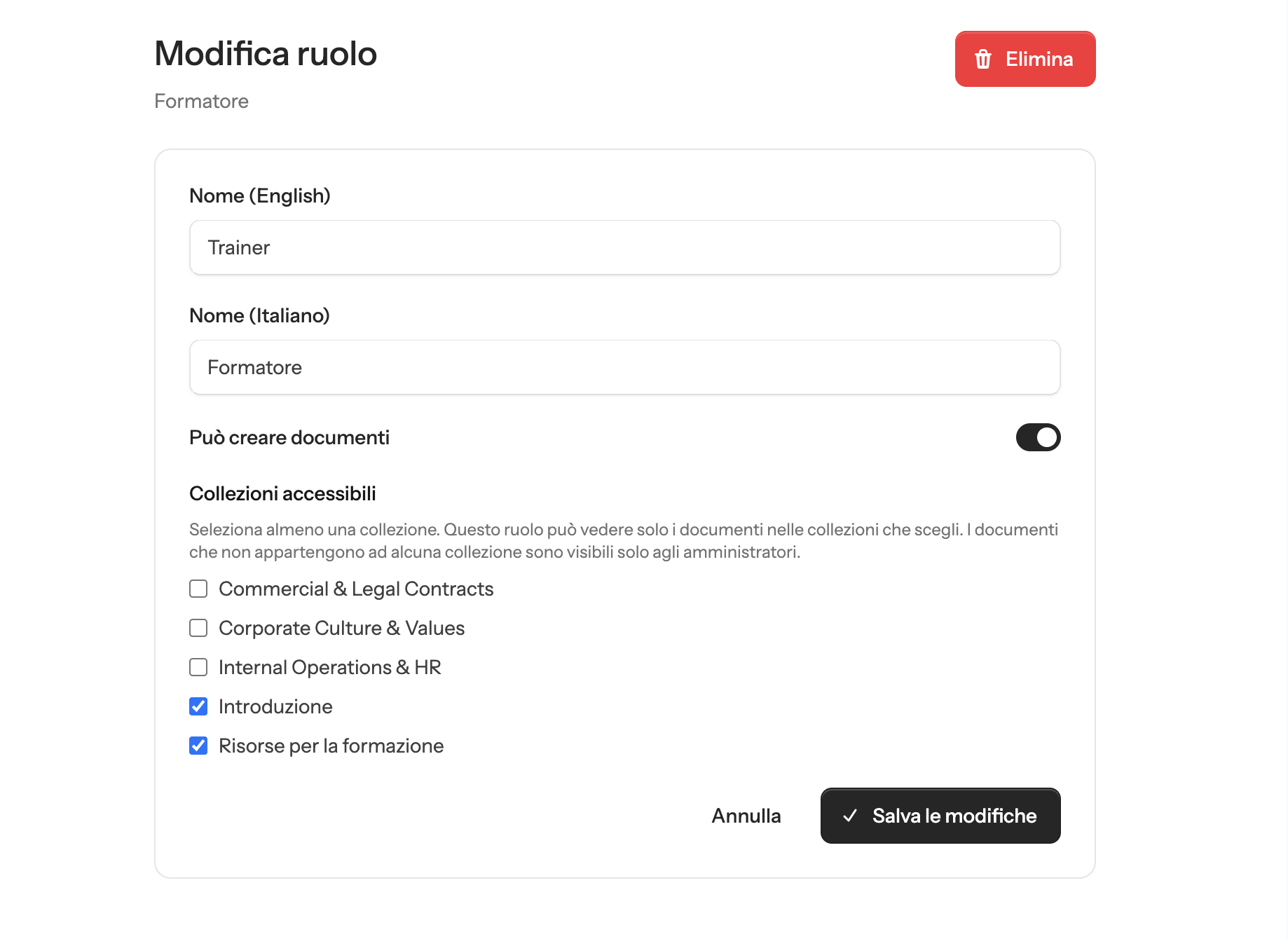
- Each role is granted specific collections. A person can see, and ask about, only those.
- The filter runs inside the database query, before retrieval. It is not an instruction in the prompt that a well-phrased question could talk its way around.
- The knowledge base and its access levels are defined by designated administrator users: which collections exist, which roles, and who sees what remain the company’s decisions.
Model agnostic
Choose your AI model yourself
Which model answers is a configuration value, not an architectural commitment. Change supplier when the pricing, the quality, or your compliance requirements change.
- OpenAI
- Anthropic Claude
- Google Gemini
- Mistral
- Kimi
- OpenRouter
- Ollama
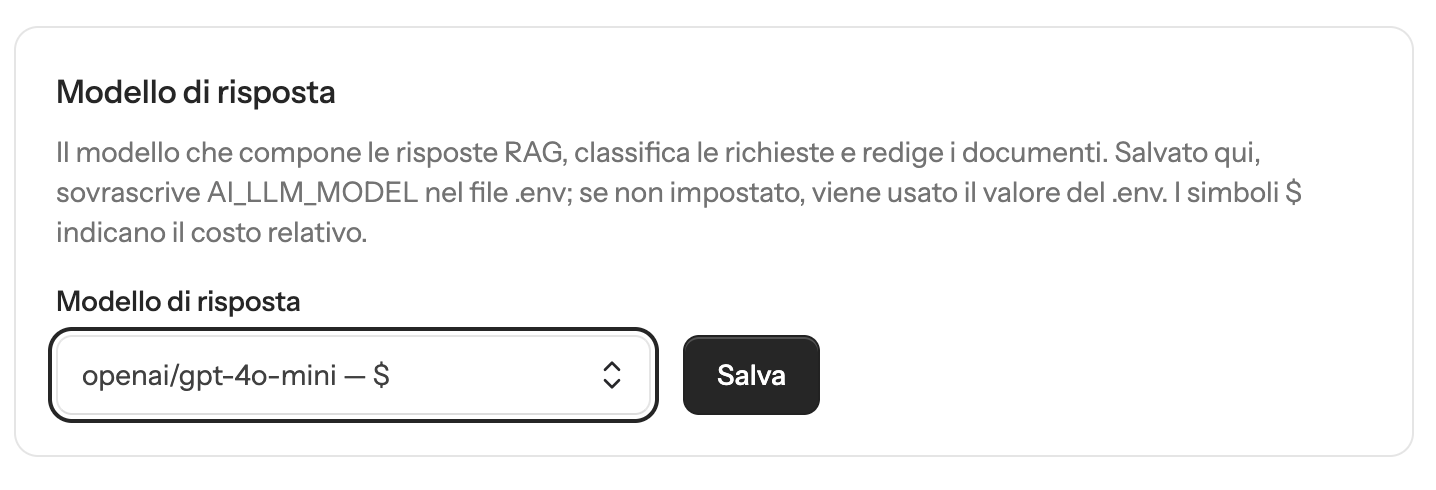
For the online demo Kmstry routes through OpenRouter, which reaches most commercial models with a single key, and an administrator switches the answering model from a settings page. It is the simplest setup to start with. For particular needs, connecting it straight to a specific provider, or to a local inference model running on your own infrastructure, is a driver change, not a significant rewrite of the application.
.env
AI_LLM_DRIVER=openrouter
AI_LLM_MODEL=google/gemini-3.7-flash
AI_EMBEDDING_MODEL=openai/text-embedding-3-small
AI_EMBEDDING_DIMENSIONS=1536
Stack and costs
Predictable costs from day one
Kmstry is a Laravel application with a Postgres vector store, talking to different AI models through Neuron AI.
- Laravel 12
- Livewire
- PHP 8.2+
- Postgres
- pgvector
- Supabase
- Neuron AI
- OpenRouter
- No per-seat AI licence. You pay for the model calls you actually make, and an administrator can switch to a cheaper model from a settings page at any time.
- To start you need hosting that can run a Laravel application, a Supabase project for the vector store on Postgres with pgvector, and an OpenRouter account whose key covers both the embeddings and the answers. Our advice is to take advantage of the elasticity and transparent costs of Laravel Cloud from the outset.
- Mature, widely used technology: ordinary maintenance, skills you can hire for, and no hidden licence fees in the stack. Our own code is released under a standard internal-use licence, written in plain language: your company uses it and modifies it for its own operations, with no bespoke contract to negotiate.
- The commercial alternatives are priced per user, per month: the bill grows with headcount rather than with usage, and you are the one adapting to the product. Here it is the other way round. Spending follows the questions your team actually asks, the product is shaped around the processes you already have, and the more the company grows, the wider that gap gets.
FAQ
Questions and answers
Does our data leave the company?
The original documents stay in your own database and storage. The indexed text and the vectors live in the Supabase project registered to you, and only the passages relevant to a given question reach the model, never the whole archive. Where requirements are stricter, the architecture allows the model, the embeddings and the vector store to move onto your own infrastructure.
Can we use a local model instead of a cloud provider?
Yes. Being model agnostic, Kmstry connects easily to different providers, for example Ollama, which serves self-hosted models on your own infrastructure.
Which languages does it work in?
The interface and the content ship in two languages, Italian and English, and more can be added when needed. Retrieval prefers the language you are working in and falls back to the other when it finds nothing, so a document written in English can still answer a question asked in Italian.
What are the initial costs?
Up front: our consultancy for installation and configuration, and the initial indexing of the knowledge base, whose embedding cost is proportional to the volume of documents. Then recurring: hosting for the application and for the vector database on Supabase, plus usage of the model calls, both for embedding new documents and for the answers. No per-user licence.
Do we need a dedicated technical team?
No. People using Kmstry upload documents and ask questions, as they would with any AI tool: no specialist skills required. We handle installation and configuration, and from then on it is looked after like any ordinary web application.
I would like to try Kmstry. What do I do?
Write to info@digitalbuilders.it asking for demo access. We set up a short call to understand what your company needs: the size of the knowledge base, the kinds of users, and any technical or privacy constraints. With a clear picture, you have a tailored quote within a few days.
Start with the knowledge you already have
Tell us what your team keeps losing time looking for, and we will show you Kmstry answering it.